If you have ever wondered how some entrepreneurs seem impossibly organized – juggling launches, client work, content creation, admin, and operations without constantly drowning – the answer is never “they just have their life together.”
It’s systems.
Always systems.
And more specifically, it’s having the right project management setup.
One of the questions I get asked constantly is:
“How do you organize ClickUp or Trello to manage all the moving pieces in your business without feeling overwhelmed?”
Because here’s the truth that no one tells you:
👉 Your project management tool is only as effective as the way you set it up.
ClickUp and Trello aren’t magic. They don’t instantly make your business feel organized just because you opened the app. In fact, when used improperly, they can be just one more place to store chaos.
But when you build a simple, intentional, business-specific setup – the kind that mirrors how your brain works – everything shifts. Your workflow becomes clear. Your tasks become manageable. Your launches gain structure. Your content becomes consistent. Your client delivery feels smoother. And your business finally feels like it has a home.
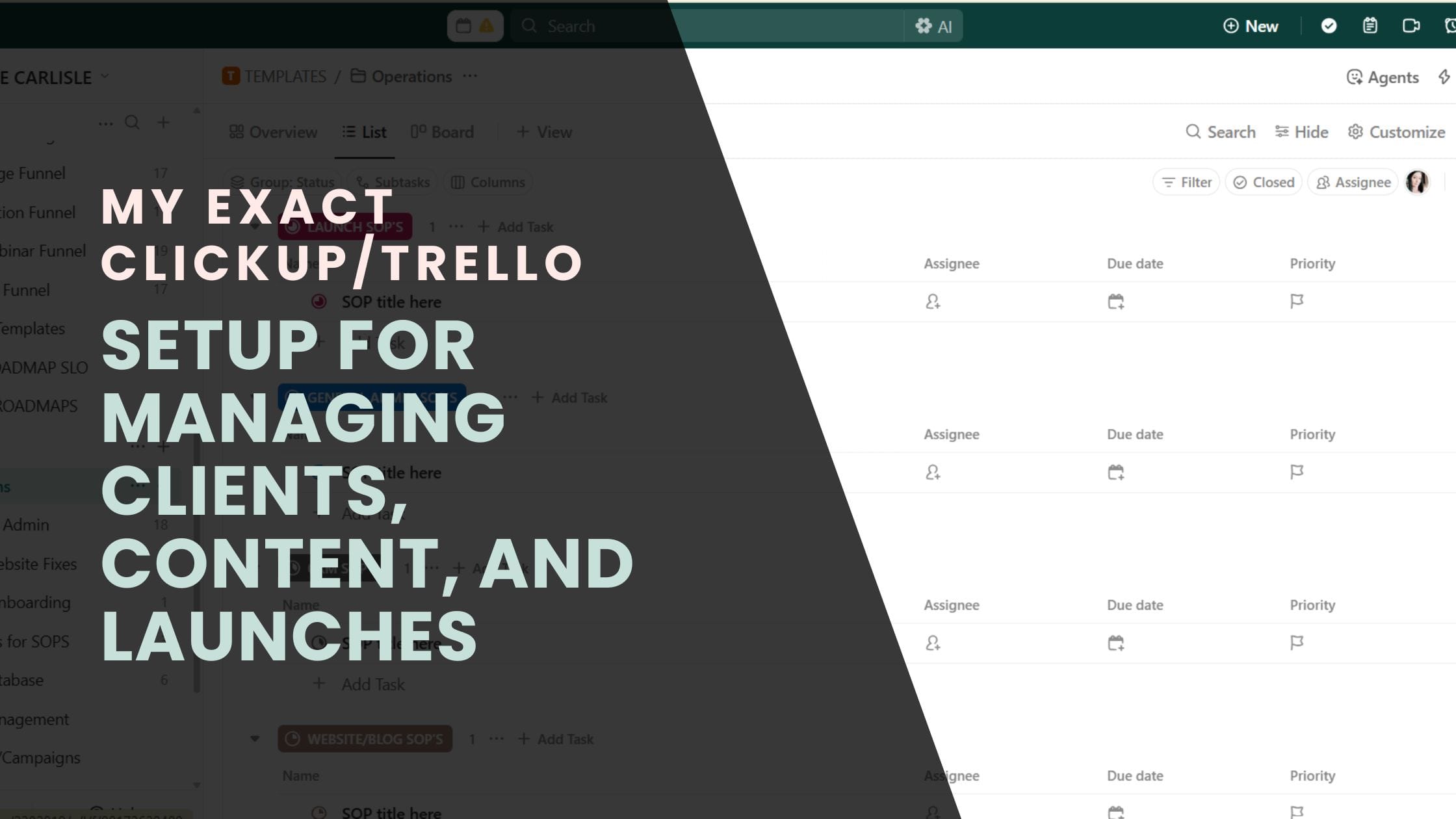
Today, I’m going to walk you through the exact structure I use in ClickUp and Trello to manage clients, content, and launches – without burnout, overwhelm, or 17 different systems scattered across platforms.
This setup works whether you’re scaling, starting, or somewhere in between. If your business has ever felt like a tangled mess of tasks, ideas, deadlines, and messages… this will change everything.
Why ClickUp or Trello Is Essential for an Online Business
Before I break down the actual setup, let’s talk about why having a centralized project management system is the difference between feeling like a real CEO and feeling like you’re running on fumes.
Running an online business means managing:
- client projects
- coaching calls
- onboarding
- content creation
- social media
- launches
- emails
- collaborations
- product development
- admin
- operations
- metrics
- team communication
- tech maintenance
If you try to hold all of that in your head (or worse – across multiple notebooks and apps), your brain stays in survival mode.
Chaos happens not because you’re disorganized – but because you’re under-supported.
A project management system is not about color-coded lists and pretty labels. It’s about creating clarity, reducing overwhelm, and giving your business a backbone strong enough to support your long-term growth.
And whether you prefer ClickUp or Trello, both tools can become the central nervous system of your business – if you set them up properly.
My Core Philosophy for Using ClickUp or Trello
There are thousands of templates online. Thousands of productivity hacks. Thousands of opinions about the “best” way to set up a business backend.
But here is the philosophy I follow and teach:
Your setup must be simple enough that you’ll actually use it – and powerful enough to support your growth.
If your system is too complex, you’ll abandon it.
If it’s too simple, it won’t hold what you need.
The sweet spot is a setup that:
- reduces your mental load
- organizes your workflow
- keeps everything in one place
- supports your launches
- gives your content structure
- tracks your client delivery
- aligns with your personal work style
The structure I’m about to share works in both ClickUp and Trello because it is built on principles, not rigid templates. You can adapt it to your platform of choice.
The Structure: Three Main Spaces That Run Your Entire Business
My entire business lives inside three core spaces:
- Client Management
- Content Creation & Marketing
- Launch Planning & Execution
Everything else – admin, operations, automations, ideas, finances – supports these three primary drivers.
These are the areas where entrepreneurs lose the most time, feel the most overwhelmed, and experience the most disorganization. By simplifying them into clear structures, your business workflow becomes a hundred times easier.
Let’s break down each one in detail.
1. The Client Management Space (Your Delivery System)
This space is the heart of your client operations.
Most entrepreneurs treat client management as a messy collection of emails, chats, Google Docs, call notes, and random tasks scattered everywhere. That’s why client delivery often feels heavier than it needs to.
Inside ClickUp or Trello, I create a clean, simple structure where each client has their own dedicated card or folder, depending on the platform. This becomes their digital home.
Here’s what lives inside each client’s workspace:
- onboarding checklist
- contract + payment details
- call notes
- deliverables
- due dates
- feedback
- resources
- follow-up reminders
- session summaries
- homework or next steps
But the magic isn’t in the list – it’s in the clarity.
When each client has their own organized space, it eliminates mental clutter. You never struggle to remember what happened in the last call or what needs to be done this week. You’re not digging through email threads trying to find information. Your clients feel supported, cared for, and well-managed because everything is tracked with intention.
Most importantly, this structure creates consistency. Even on low-energy days, you can open your tool, click a client’s space, and instantly know where things stand.
This alone elevates your professionalism and reduces overwhelm dramatically.
2. The Content Creation & Marketing Space (Your Visibility Engine)
If we’re being honest, content is one of the biggest sources of stress for online entrepreneurs.
Not because content is hard – but because content is constant.
Ideas appear at random. Drafts get lost. Graphics sit in Canva. Captions live in your notes app. Reels are half recorded. Blog posts live in Google Drive. Plans fall apart because visibility doesn’t have a system.
But when you create a content HQ inside ClickUp or Trello, everything changes. You now have a single place to create, store, schedule, and repurpose content.
My content board includes:
- an idea bank
- a content calendar
- drafts in progress
- posts ready to schedule
- scheduled posts
- analytics snapshots
- a repurposing plan
But the key is not the categories. It’s the workflow.
When you move content through a structured flow, you eliminate the confusion of “What do I post today?” and instead operate with strategy. You can batch content, repurpose ideas, plan ahead, and show up consistently – without burning out.
One of the biggest benefits of this setup is that it ties directly into your launch planning. Your content supports your offers, your warm-up sequence, and your conversion strategy because everything is mapped in one place.
Content becomes easier, faster, and more aligned because it’s no longer a guessing game – it’s a system.
3. The Launch Planning & Execution Space (Your Revenue Accelerator)
Most entrepreneurs dramatically underestimate how many moving parts a launch contains. A launch is not just emails and social posts – it’s a full-scale project involving tech, content, messaging, deliverables, timelines, segmentation, customer journey planning, onboarding, and follow-up.
Without a project management system, launches feel chaotic. With one, they feel predictable and strategic.
Inside my Launch HQ space, I organize everything needed for a successful launch. This includes the strategy, the timeline, the funnel map, the content, and the tech.
My launch space includes sections for:
- offer clarity
- customer journey map
- warm-up marketing plan
- email sequence drafts
- content schedule
- live event or webinar planning
- sales page outline
- tech setup checklist
- reminders and testing
- metrics and debrief
But what matters most is the flow.
Your launch planning space becomes a living map of your revenue goals. Instead of scrambling during launch week, everything has already been organized, assigned, and clarified.
This kind of structure doesn’t eliminate the energy required for launching – but it does eliminate the panic. You know exactly what to do, when to do it, and how to execute your launch without the last-minute scramble.
Most importantly, it allows launches to become repeatable. A launch that is documented is a launch that can be duplicated, optimized, and scaled.
How These Three Spaces Work Together
This is the part most people underestimate: these spaces are not separate. They are interconnected.
Your content supports your launches.
Your launches attract new clients.
Your onboarding flows into client management.
Your client results turn into content.
Your offers evolve into new launches.
Everything in your business is connected – so your systems must reflect that.
When ClickUp or Trello becomes the place where all these moving pieces meet, your business becomes more stable. You no longer feel like you’re juggling flaming torches while riding a bike blindfolded.
Instead, your business starts to feel like a well-managed, well-planned, well-supported ecosystem.
The Difference This Setup Makes in Your Day-to-Day Business Life
The transformation is immediate and profound.
You wake up knowing exactly what to work on.
Your launches stop feeling like emergencies.
Your content becomes consistent instead of sporadic.
Your clients feel cared for because nothing slips through the cracks.
Your mental load becomes lighter.
Your creativity increases because your brain is no longer cluttered.
Your revenue becomes more predictable.
And your business finally feels like it’s running on systems – not stress.
This setup doesn’t make you more “productive” – it makes you more supported.
It turns chaos into clarity, overwhelm into order, and scattered ideas into strategic execution.
The Bottom Line: Your Business Needs a Home – and This Is It
ClickUp and Trello are just tools.
But the way you use them determines whether your business feels grounded or chaotic.
When you build a simple, strategic setup – one that holds your clients, content, and launches with clarity – everything gets easier. You stop winging it. You stop guessing. You stop living in your head.
And instead, you start leading from a place of structure, confidence, and vision.
Your business finally has a home.
And inside that home, your role as CEO becomes clear, powerful, and sustainable.

